Project Background
In January 2017, the "Guiding Opinions of the State Administration of Work Safety on Strengthening the Safety Risk Assessment of Reactions in Fine Chemicals" [Safety Supervision General Manager III [2017] No. 1] (Guidelines for Safety Risk Assessment of Reactions in Fine Chemicals (Trial)) clearly requires enterprises to conduct reaction risk assessments;
On February 26, 2020, the General Office of the Central Committee of the Communist Party of China and the General Office of the State Council issued the "Opinions on Comprehensively Strengthening the Safety Production of Hazardous Chemicals", emphasizing the acceleration of the formulation of technical specifications such as safety risk assessment of fine chemical reactions;
On July 20, 2020, the General Office of the Guangdong Provincial Committee of the Communist Party of China and the General Office of the Guangdong Provincial People's Government issued the "Implementation Plan on Comprehensively Strengthening the Safety Production of Hazardous Chemicals", Guangdong Banfa [2020] No. 16;
On March 3, 2021, Guangdong Provincial Work Safety Commission, Guangdong Provincial Emergency Department, Guangdong Security Office [2021] No. 28.
Significance of the project
Chemical reaction safety risk assessment has the following five important significances:
1. Conduct reaction heat assessment on dangerous chemical reactions and provide quantifiable test data;
2. Assess the risk of hazardous reactions and take preventive measures to avoid accidents;
3. Provide thermal stability data of chemical substances for process optimization;
4. Strengthen risk management, identify and evaluate hazardous and harmful factors and risk levels in the operation process, equipment and facilities;
5. Eliminate or reduce accident hazards, reduce safety risks, and control major risks within an acceptable range;
Assessment Scope
1. Intermittent and semi-intermittent reactions in enterprises involving hazardous chemical processes and metal-organic synthesis reactions (including Grignard reactions) that are subject to key supervision;
2. A new process or new formula used for the first time is put into industrial production; the existing process route, process parameters or device capabilities are changed (new, modified or expanded);
3. New technology introduced for the first time abroad;
4. Production safety accidents have occurred due to problems with the reaction process.
5. Reaction processes involving hazardous chemicals prone to explosives and hazardous chemicals regulated by the state
6. The thermal stability of raw materials, semi-finished products, products and waste needs to be assessed;
7. Some non-reactive processes, such as distillation, product purification operations, etc.
Appraisal Process
The chemical reaction safety risk assessment process mainly includes: reaction risk assessment, HAZOP analysis, SIL classification (LOPA method), the details are as follows:
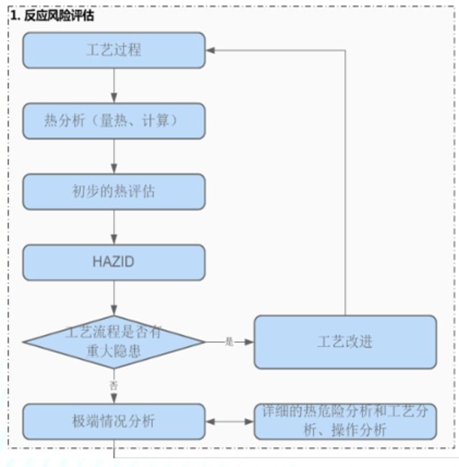
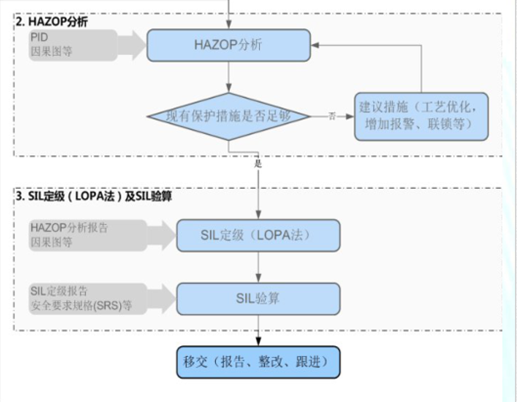 Reaction Risk Assessment
Determining the risk of the reaction process, thereby improving the design of safety facilities and improving risk control measures, can improve the intrinsic safety level of the enterprise and effectively prevent accidents.
HAZOP analysis01
Conduct risk identification and risk assessment on chemical equipment, analyze whether to set up a SIS system and determine the basic work of SIL level. HAZOP analysis identifies unsafe factors and hazard sources by presetting abnormal working conditions scenarios, and further analyzes the consequences and possibilities of the initial event. SIL rating, also called safety integrity level, is a method of expressing the safety function level of instrument meters. It is generally divided into SIL1-4 levels, which are divided into hardware and software integrity levels. According to the aging mode, it is divided into low requirement mode and high requirement mode.Provide services
1. Chemistry and chemical reaction safety risk research and assessment, enterprise existing reaction process potential risk assessment, enterprise expansion or technical transformation of new reaction process risk assessment, new enterprise reaction process risk assessment before production, hazardous reaction process (mandatory) assessment, reaction kinetics and simulation calculations, chemical chemical reaction safety risk research;
2. Chemicals (raw materials, semi-finished products, finished products), waste stability analysis, chemical hazard identification and classification, unsteady solid material stability testing, chemical safety data sheets (SDS), dust and flammable gas testing, chemical use, storage, transportation, waste risk analysis;
3. Chemistry, chemical reaction safety process design, safety reaction process development, energy saving, consumption reduction, safety, environmental protection reaction process optimization pilot test, trial production, emergency release system design based on DIERS method;
4. Chemistry and chemical reaction safety risk management monitoring, government department safety supervision, chemical industry park enterprise reaction process screening, corporate environmental assessment, safety assessment chemical engineering design department production design, safety accident cause analysis;
Our Competitive Advantage:
It has a complete reaction risk assessment test equipment system: including micro-reaction calorimeter (uRC) and reaction calorimeter (RC1) for target reaction assessment, accelerated calorimeter (ARC) for out-of-control reaction assessment, rapid screener (RSD) for thermal stability screening, differential scanning calorimeter (DSC), rapid scanning adiabatic calorimeter (ARSST), etc.;
It has relatively complete safety assessment software: Thermal Safety Software (TSS), which is specially used for in-depth processing of process safety data, can create complex dynamics and completely simulate actual situations through numerical simulation methods.
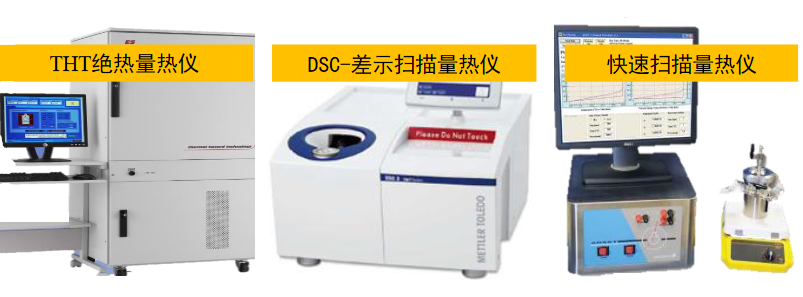
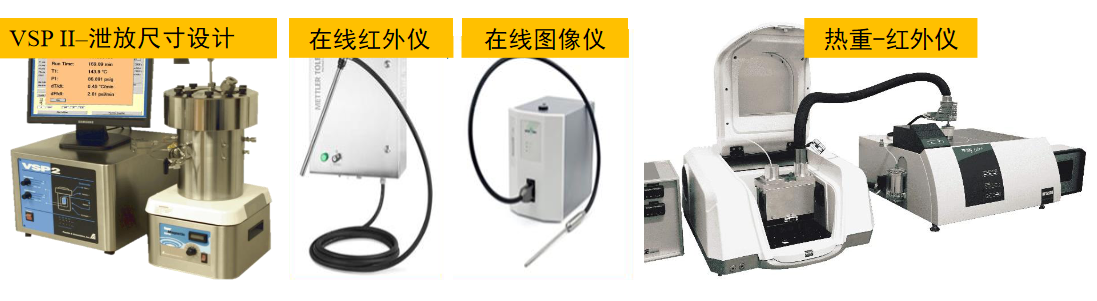
It has a variety of large-scale instruments for safety process development: Mettler's fully automatic reaction platform, such as online infrared instrument, online imager, online viscometer, etc., as well as a specially designed reactor emergency release system (VSP2); it has relatively complete safety assessment software: such as Thermal Safety Software (TSS), which is specially used for in-depth processing of process safety data, which can create complex dynamics and completely simulate actual situations through numerical simulation.
Possess chemical reaction safety risk assessment qualifications:


